Career Counseling
Career Counseling
Overview of the Career Counseling Program with Tim Wilkins, PhD, LPC
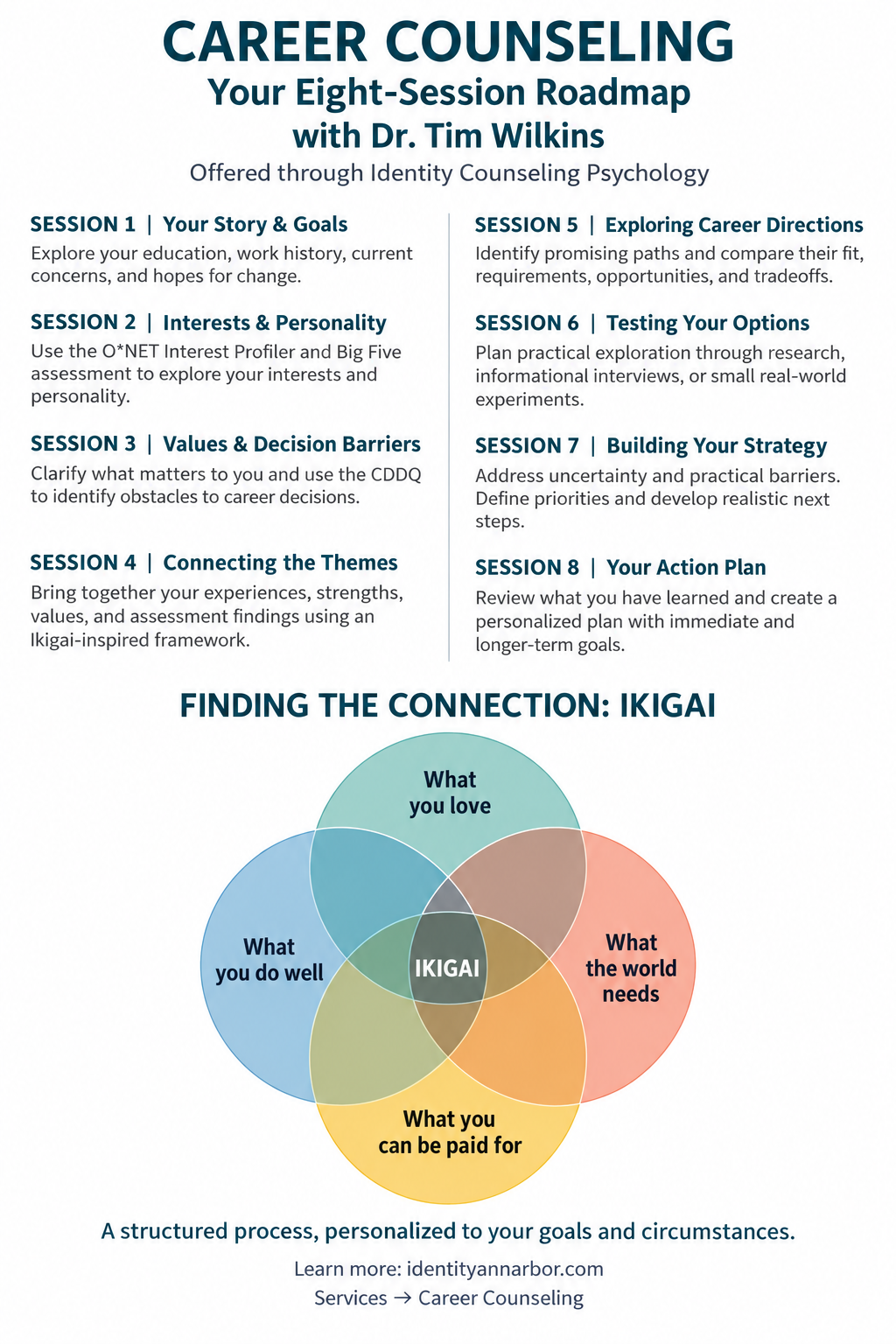
IKIGAI: the intersection of...
- What you love
- What you are good at
- What you can be paid for
- What the world needs
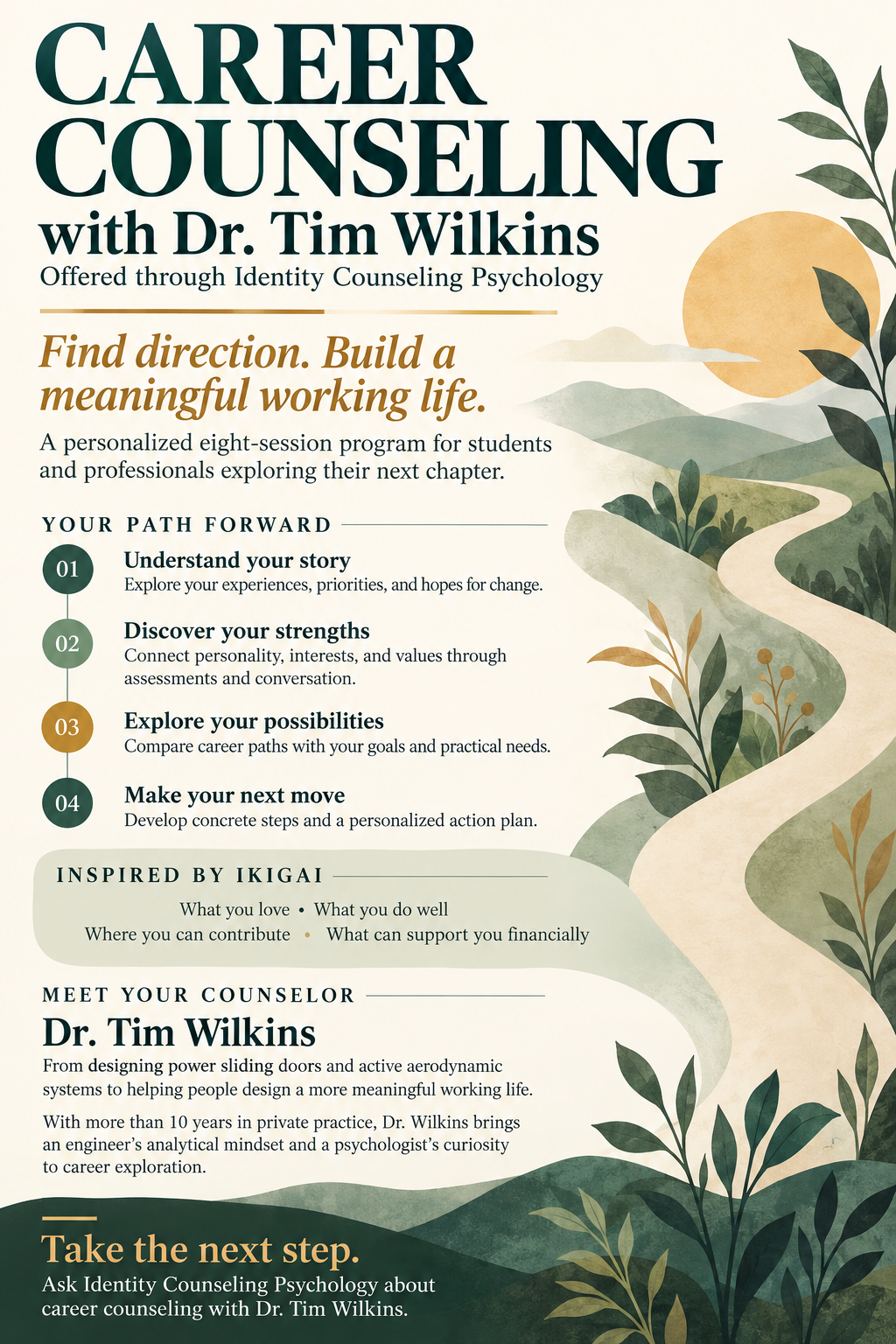
Choosing a career means making decisions about how you want to spend your time, use your strengths, and build your life. That can feel overwhelming, whether you’re choosing a college major, questioning your current work, or considering a new direction after years in the same field.
At Identity Counseling Psychology, our eight-session Career Counseling Program combines personal exploration, structured assessments, and practical planning. Together, we’ll explore what matters to you, identify promising career directions, and develop concrete steps toward work that fits your interests, values, and life circumstances.
Who is the Career Counseling Program for?
Our program is designed for high school and college students, recent graduates, and working professionals who want greater clarity about their next steps. It may be helpful if you are:
- Choosing a college major, training program, or initial career path.
- Feeling dissatisfied, unfulfilled, or stuck in your current work.
- Considering a career change but unsure where to begin.
- Struggling to choose between several interests or possibilities.
- Finding that anxiety, self-doubt, or others’ expectations are complicating your decisions.
- Looking for work that better fits your strengths, priorities, and responsibilities.
You do not need to arrive with a clear goal. Helping you develop that clarity is part of the process.
How does the Career Counseling program work?
The program follows an eight-session structure, with exploration and activities tailored to your needs. We consider your personality, interests, values, experiences, and practical circumstances together, including income needs, education requirements, family responsibilities, and your willingness to pursue additional training.
Session 1: Understanding your story
We begin by exploring what brought you to career counseling. We’ll discuss your education and work history, meaningful experiences, current concerns, and what you hope will change. We’ll also look at what has felt energizing, frustrating, or missing in your work and life.
Sessions 2–3: Assessments and self-discovery
We use structured assessments and guided reflection to develop a clearer understanding of you. Tools may include the Big Five personality assessment, O*NET Interest Profiler, and Career Decision-Making Difficulties Questionnaire.
These findings help us explore your personality, occupational interests, and barriers to making a decision. We’ll also examine your values, strengths, preferred work environments, and the activities that give you a sense of purpose.
Sessions 4–5: Connecting the findings to career possibilities
Together, we’ll identify patterns across your experiences and assessment results and use them to develop potential career directions. We’ll explore why particular options may fit, where there may be tradeoffs, and what questions need further investigation.
This process considers traditional and nontraditional paths, including changes within your current field. Assessments inform our conversations; they do not determine a single career you are supposed to pursue.
Sessions 6–7: Exploring options and developing a strategy
We’ll compare your strongest options against your priorities and real-world circumstances. We’ll also address barriers such as fear of making the wrong choice, perfectionism, uncertainty, or conflicting expectations.
Depending on your goals, next steps may include researching training programs, conducting informational interviews, exploring job shadowing, or trying a small project before committing to a larger change.
Session 8: Creating your action plan
In the final session, we’ll bring together what you’ve learned and develop a personalized plan for moving forward. We’ll identify your most promising directions, immediate next steps, longer-term goals, and ways to evaluate your progress.
Our Framework: Finding Direction Through Ikigai
Our Career Counseling Program draws on ikigai, a Japanese concept often translated as “a reason for living.” In career exploration, it offers a starting point for considering how work can contribute to a meaningful and satisfying life.
We use the familiar four-part career model inspired by ikigai to explore:
- What you love: The interests, activities, and experiences that draw you in and give you energy.
- What you do well: Your strengths, existing skills, and abilities you would like to develop.
- Where you can contribute: The people, problems, or causes you care about and the contribution you want to make.
- What can support you financially: Opportunities that align with your income needs, responsibilities, and desired lifestyle.
We connect these questions with your assessment results, personal history, and practical circumstances to identify promising career directions. We also explore where these areas conflict and which tradeoffs you are willing to make.
You do not need to find one career that fulfills every part of your life. Meaning can also come from relationships, family, creativity, and community. Our goal is to help you understand the role you want work to play and move toward a path that feels personally meaningful and financially sustainable.
What can I expect to gain?
The goal is to leave with a clearer understanding of yourself, a focused set of career possibilities, and a practical plan for exploring or pursuing them. Career decisions often involve uncertainty, but you can learn to make them with greater confidence and a stronger sense of what matters to you.
Career exploration is also personal exploration. Throughout the program, we make room for questions about identity, meaning, relationships, and the kind of life you want your work to support.
Meet Dr. Tim Wilkins

I’ve gone from designing power sliding doors and active aerodynamic systems to helping people design a more meaningful working life.
My career began in mechanical engineering after earning my degree from the University of Michigan. I later earned a master’s degree in counseling psychology from Western Michigan University and a PhD in clinical psychology from Fielding Graduate University. For more than 10 years, I have worked in private practice, helping people navigate personal challenges, strengthen relationships, and find direction.
My own career transition informs how I approach this work. I understand that choosing a new path involves more than identifying what interests you. It can mean reconsidering your identity, weighing financial and family responsibilities, and questioning what to do with the years you’ve already invested.
I bring an engineer’s analytical mindset and a psychologist’s curiosity about people to career counseling. Together, we’ll connect your strengths, interests, and values with practical possibilities and develop a plan that supports the life you want to build.

Identity Counseling Psychology
2155 Jackson Ave
Ann Arbor, MI, 48103